
Cheek Piercings – Dangers & Dimples.
Cheek piercings are not common to see. They look cute – sure – and thanks to pinterest and other social media, people are seeing them and, of course, wanting them, more and more. In the last 3 months, I have had about 8 requests for them. Of those 8, I have done…. none. This blog will outline the risks of cheek piercing, and why I (and many, many other piercers) are reluctant to offer them as readily as other procedures.
Examples of cheek piercing:
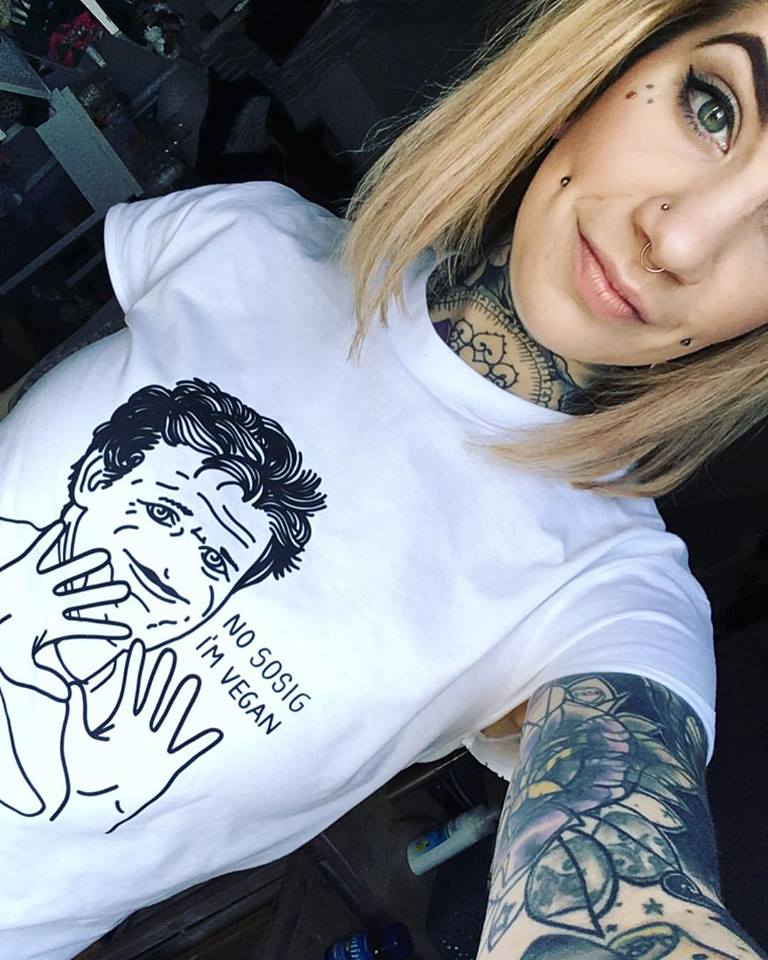
Lucy – Piercings self done.
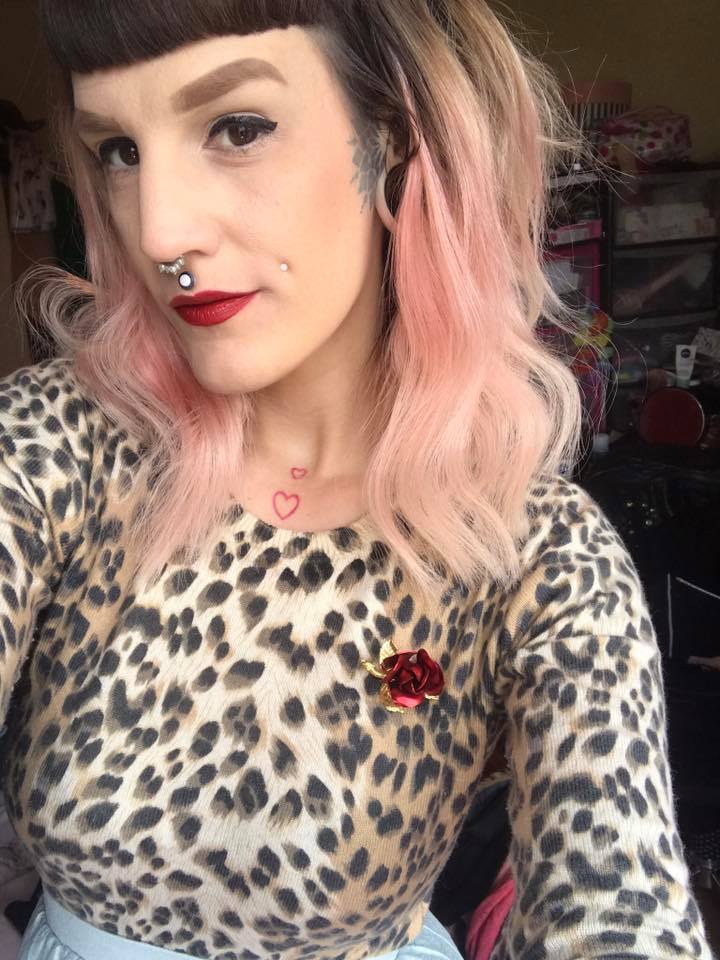
Salem – Piercings by me.
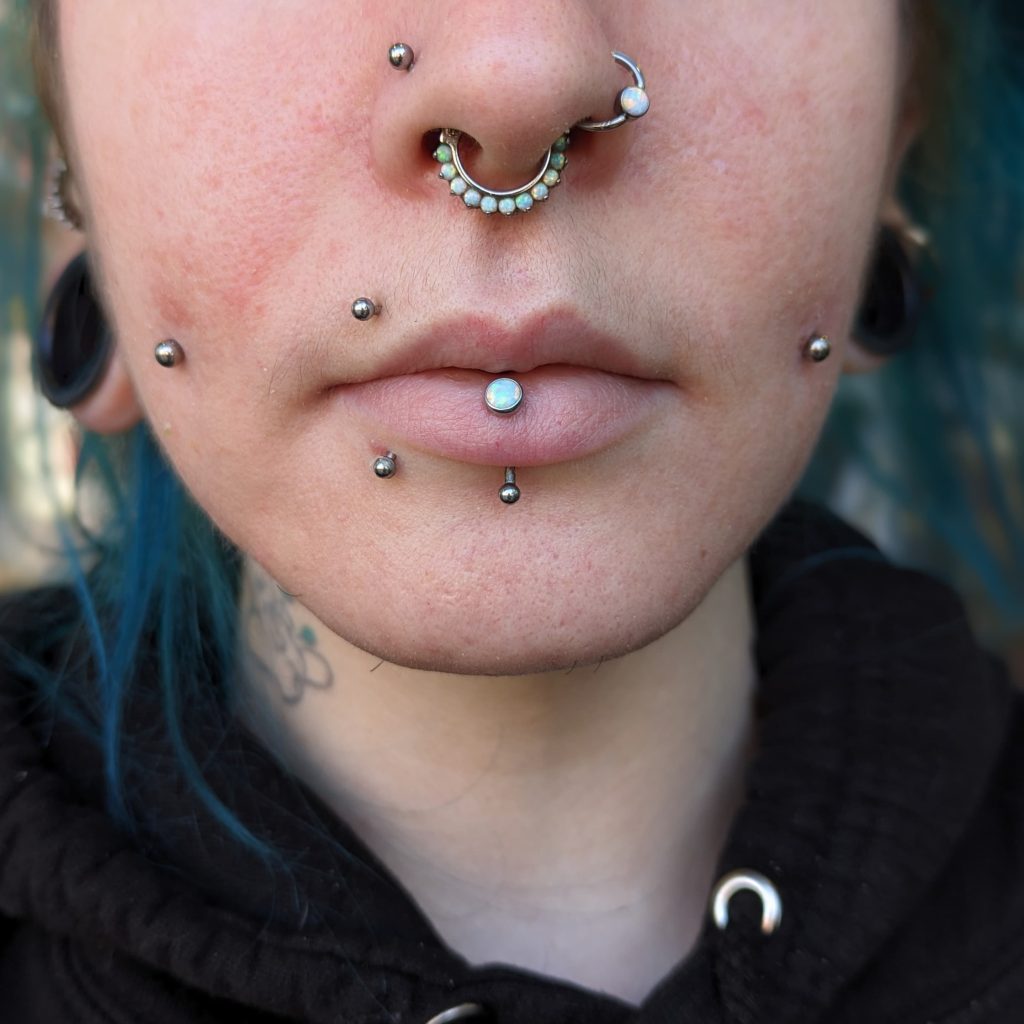
Zoe – Piercings by me (pic taken at 1st downsize)
Blog on Cheek Piercing by Lynn Loheide: https://www.lynnloheide.com/post/cheek-piercings-an-in-depth-look
Dahlia piercings are also included in all of this, which is a piercing more to the corner of the mouth than the cheek, they are less common to see but they present the same risks and issues. Many may see dahlias as ‘easier’ than cheeks, and I would agree, but that does not mean that the issues and risks are zero.
Examples of dahlia piercing:
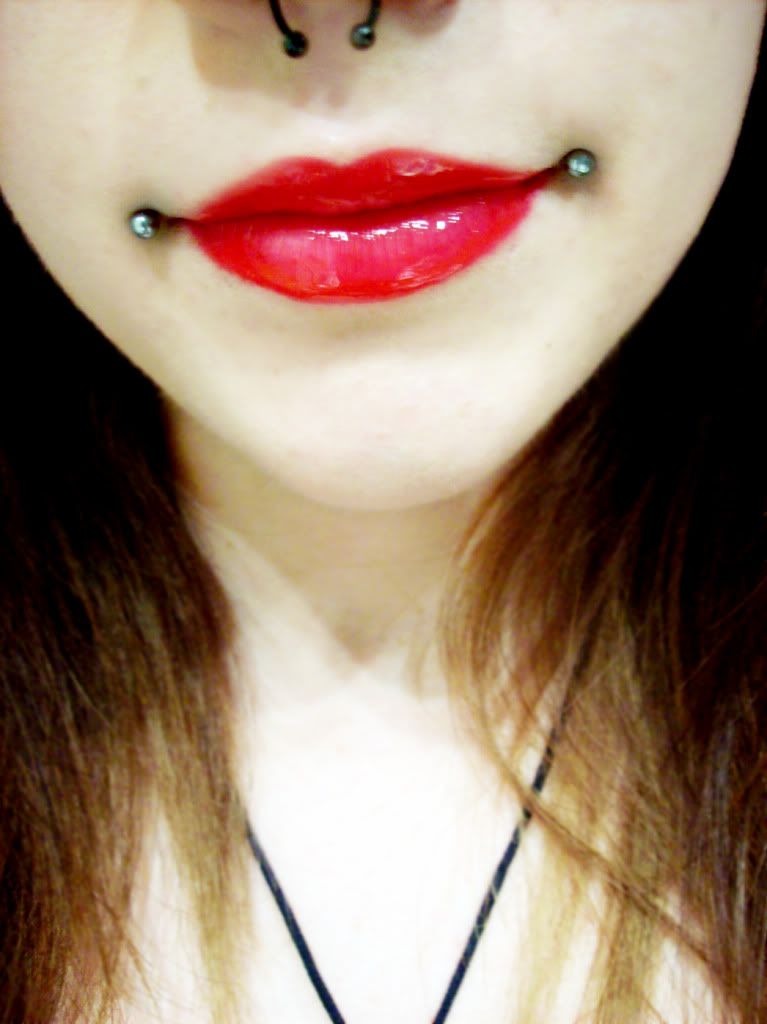
Model/Piercer unknown (please post credit in comments if you know!)
Blog on Dahlia Piercing by Lynn Loheide: https://www.lynnloheide.com/post/dahlia-piercings-101
Why Are Piercers Reluctant To Offer Cheek Piercings?
So, firstly, I’m very particular on who I will work on for cheeks, and most other piercers are too. This is a fact, and anyone considering this procedure should be prepared to hear a ‘No’. There’s no hard and fast rules, but it’s safe to assume that unless ALL the following apply to you, it’s a ‘No’ from me.
- Have been pierced by me before, several times.
- Have (or have had) other facial piercings.
- Consistently follow aftercare and return to me with happy, healthy & healed piercings.
- Are 18 years of age or over.
- Live (or usually live) within easy travelling distance of the studio.
- Are prepared for the larger-than-usual financial outlay of a piercing which can involve multiple downsizes, as well as the longer-than-average healing time.
- Have read this blog, I guess, to be aware of the risks.
- Have been considering the piercing for 6 months or more.
I’ve had people beg, shout, have tantrums…. If you do this, it turns any chance of a ‘Yes’ into a firm, and permanent ‘No’. Please respect a piercer’s decision on whether they will or won’t pierce you – not just with cheeks, with ANY piercing procedure.
Why Do You Ask These Things?
Cheek piercings are – in short – a nightmare to get, have, heal and keep happy, which you will know all about by the end of this blog. I want happy piercings and happy clients. I do not want someone with excessive scarring, who is now unhappy with their face shape (yes, this piercing will change your face permanently – we’ll get to that) on my conscience. Sure, for all the people I have turned away, I’m sure they have gone elsewhere and had the procedure done. But that isn’t on my shoulders.
Points 1-3 raised above:
If you haven’t had a lot of experience with piercings, starting out with – arguably – one of the hardest to heal is a bad idea. If you don’t heal well, and don’t follow aftercare consistently, you will not have an easy time with these. If I haven’t pierced you before, I don’t know you, I don’t know how well you take care of your piercings (point 3) and I would not want someone whom I have never met before taking on a huge burden, courtesy of me, when I don’t know if they will trust me to help and come back to me if there is an issue.
Point 4
Cheek piercing is a PERMANENT change to your face. Even if the jewellery is removed, the scars and dimples left are there forever. Your face shape will be permanently changed. As this is a permanent change, you need to be 18+. There are surgeries that will correct this, but they are expensive and scarcely offered.
Point 5 & 6
Cheek piercing requires multiple downsizes and often causes a lot of issues – I need you to be able to get back to me easily in case an issue presents itself. And for those downsizes as they need to be done – leaving too-long jewellery in a piercing for longer than necessary will irritate it and cause it to swell up again, more scarring, and potentially need to be upsized (longer jewellery put in) instead. I’m not saying I will only work on people who live within walking distance of where I am working, but if you don’t have a great deal of free time to call back, and the ability to get to the studio whenever you (or I) require it, you’re putting more dangers into the mix. The cost of jewellery is not something many people consider, but 6-10 downsizes is not uncommon. If we average that out at 8, for a pair of cheek piercings, that’s 16 barbells/labrets you need to pay for. The healing time on cheek piercings is, on average, one of the longest for any piercing. Any cheek piercings that heal fully in under a year, I’d say have healed quickly. While the swelling may be gone after a few months, for the wounds to heal fully, I would expect 18 months.
Point 7
Hello – hopefully this blog will outline the risks you will have – it’s not meant to scare you off, but after hearing about the dangers, most people will spend at least a little more time considering it
Point 8
So, I guess anyone can lie about how long they have been considering this. But let’s look at it this way – would you get a tattoo on your face after a couple of weeks of thinking? So why not give equal thought to something which will change your face permanently?
Even if all the above are met, if I don’t feel the client is ‘right’ for me, I will still refuse the work. Maybe I’ll lose a client, maybe I’ll be called a bitch, but as mentioned, there’s no hard and fast rules with this, I’d rather lose that ‘sale’ (it’s never about the money, trust me) but sleep well knowing that it’s not me that has caused someone a lot of pain and upset.
So, What *ACTUALLY* Goes Wrong? What Are The ‘Healing Problems’ Talked About?
With the procedure – if it is carried out in appropriate conditions/environment with an experienced piercer and a calm client, very little can go wrong with the procedure itself. It is paramount that the cheeks are checked thoroughly for blood vessels and saliva ducts – to make sure neither are present in the area being pierced. Marking them can take AGES too – but that’s not really a risk. Personally, I will schedule appointments for cheeks so I have an hour with the client. Oh, and never pierce further back than the 1st molar tooth as a rule of thumb.
Scary story about this: http://piercingbible.com/cheek-piercing-dangers
The handful (and I mean 20 or so) of pairs of cheek and dahlia piercings I have performed in my career, not one person has said the procedure was particularly painful. This is not the issue.
NOT checking for blood vessels could cause a bleed. Using unsanitary equipment or being pierced in an unsanitary environment could massively raise the risk of infection – though these are true of any piercing, not just cheeks.
Bleedy story: http://piercingbible.com/blog/2012/07/more-cheek-piercing-dangers
An inexperienced piercer could miss something, misplace the piercings, or even fail to get them at the right angle. Sure, this is a cosmetic issue, not a real ‘risk’ – but something to consider.
One could argue that once the piercing procedure is done (safely, consensually and to the highest standard), the entirety of the piercer’s responsibility is over with. Anything that happens after this is down to the client and their responsibility. From a legal standpoint, yes. But piercers are (should be!) sensitive and sympathetic to their clients, and do not want them to undergo any pain, trauma and problems – despite it not being our responsibility, we want our clients to be happy, and we want to help them. Things following the procedure *ARE* the responsibility of the client. But these problems are reported back to us and we feel we are responsible for the after-effects of something *WE* did to someone.
Once the procedure is complete they will SWELL. I don’t mean a little puff up here and there, we’re talking hamster-with-an-allergic-reaction swelling. The length of the bars will reflect this. And this swelling will be present for several days, I would expect the 1st downsize after about 7-10 days, but this would NOT be all the swelling gone. Just the worst over – and there is always a risk of this coming back, and needing to upsize the bars when you get these ‘flare ups’ – which can happen even after months/years of the piercings being ‘happy’.
Once the swelling is under control and any bruising (yep, that happens too) has gone, you start getting back to normal. Except:
You can’t wear makeup over them.
Gents, you must be vigilant with keeping facial hair short and make sure no hairs are trapped in the piercing channel (ideally, they would be placed away from anywhere with thicker hair growth though).
They are likely to leak saliva. Yep. Spit coming out of your face-holes.
The barbells can damage your teeth very easily – so you MUST be careful.
No alcohol – it can cause issues with healing, and if you’re feeling particularly ‘refreshed’, you’re likely to chomp on the bars, or smush them about. Or even have a bit of a sick, which is just great in healing wounds in your mouth. Not.
No pet cuddles. Animal hair and dander can really irritate the piercings while healing – again, this is true of ay piercing but can you go [possibly] a year or more without nuzzling your cat/dog/rabbit/whatever? I know I can barely manage a day.
Returning to your piercer every 4 weeks or so for downsizes. Or upsizes. Or getting there and your piercer feeling that they can’t be downsized, sending you home with NO changes made after you have travelled, paid for parking, taken time out of your day, etc.
Could you manage all this? Sure, most of the above is ‘only until they are healed’ – but the leaking and tooth damage (even after downsizing jewellery) are a CONSTANT issue.
*IF* they heal, awesome – but many people experience a prolonged healing time (a year and a half I would say is ‘average’) and often decide to retire the piercing.
It is extremely common to see cheek piercings with larger hypertrophic scars (‘lumps’) on them, which will shrink, and come back, shrink, come back…. And so on – sure, it’s more than possible to get rid of them and keep them away, but it’s hard, and relies on a lot of luck as well as vigilant care.
If they are removed, those dimples/scarring are/is PERMANENT. Decide you don’t suit/like the piercings/dimples? Tough, they’re staying. In some cases, the piercing channel may not close entirely, meaning the ‘leak’ will persist.
Why Are They So Hard To Heal & Maintain?
Cheeks are THICK. I would expect a healed pair of cheek piercings to need a 10mm or 12mm pair of labret studs. This is with the piercing site being ‘pulled in’ and needing a shorter length than an ‘unpierced’ cheek’s thickness, which of course varies from person to person, but could be as much as 20mm. When first pierced, cheeks need a longer bar, usually 18-26mm (though this does vary greatly from person to person). The longer the fistula (hole/tunnel), the longer it will take to heal.
The area we’re putting a hole in moves. A lot. Every time you open your mouth – to speak, to eat, to pull a silly face…. They’re gonna move. Moving = irritation = lumps and bumps and scars (oh my).
Mouths are a bit icky. They’re wet all the time. Bacteria thrives in warm, moist (sorry!) environments. So, your mouth is party town for bacteria. Sure, mouthwash (alcohol free!) is great for an easy clean – but this must be done a LOT and for a LONG time.
Any piercing carries 4 basic rules:
Keep it clean.
Don’t move it around.
Return to your piercer if worried.
Dry it if it gets wet, do NOT soak it.
Cheek piercings make all 4 of these hard to do (‘return to your piercer’ is a LOT more frequent while healing these, or at least potentially more frequent due to the risks.)
But Once Healed, It’s All Good… Right?
Sorry…. But no! Or at least, not every time and/or for ever. As mentioned above, there’s still a risk of tooth damage (true of any oral piercing) or ‘leaking’ – saliva coming out through the holes – even when healed. Many people with cheek piercings report ‘flare ups’ – a piercing that has healed well, but occasionally, will swell, be sore, maybe even some discharge from it. Again, this is related to how easy it is for bacteria to breed in your mouth. Hypertrophic scars can form (often confused with keloids) which is an inflamed lump of scar tissue – these often come and go on other piercings too, but are extremely common on cheeks. While hypertrophic scars can be cared for and minimised, the reasons they appear (irritation/inflammation) are just constantly present with this piercing placement. See later in the blog for testimonials from people who have/have had cheek piercings.
What Jewellery Can You Use?
Jewellery size depends entirely on the client – I generally use 1.6mm (14g) jewellery for these, but it’s common to see larger gauge jewellery. I wouldn’t recommend any smaller than 1.6mm. Length will vary – as discussed – depending on how old the piercing is and what the client finds comfortable. Straight titanium (or other safe metal) bars – either barbells (removeable ball on each end) or labrets (fixed, flat disc on one end – worn inside the mouth and removeable ball on the other). Curves and flexible bars are not really suitable; curved bars put pressure on the entry and exit holes of the piercing, and turning and sliding back and forth will irritate the piercing (remember, movement = bad!) and the flexible bars put pressure on the ‘inside’ of the fistula (hole) when they bend, and often have sharp edges on the threads and from being cut to size, because they are soft(er than metal) they can also be damaged easily – scratched (bacteria can hide in those tiny scratches), warped and chewed on. I once pulled a pair of plastic labrets out of a smoker’s cheeks which were bright yellow – stained from the nicotine, since switching to titanium bars, she has found them far comfier. As for ‘fancy stuff’ – the ‘outside’ ends can be changed for an infinite amount of jewellery, though its best to keep it simple with balls or discs (rather than claw-set gems or ornate ends) while healing, and for ‘every day’ wear, and keep the fancy stuff for showing off, nights out and special events (when healed).
Can The Scarring Be Reduced Or Removed?
There are procedures that can remove the scarring left, and plump out the cheeks. However, they are not cheap, nor easy. Recovery can take some time, and there will still be SOME scarring left from the reversal. As with any scar, it depends on the person. Vitamin E creams and oils can help, but nothing will take them away completely. This also isn’t something that is readily available – your piercer cannot do this for you, you need to speak with a body modification artist or plastic surgeon.
Is There An Alternative? I Just LOVE The Look Of Them!
Firstly, consider if you would suit these piercings. As a rule, they work better on people with round or square faces – as they pull your cheeks in, they can elongate a face. So, people with oval/long faces may find it makes their face look longer.
It might be worth getting a photoshop-savvy friend to edit a pic for you. Or use some stick-on gems to get a feel for it (bear in mind the gems will NOT pull your face in to give the look of dimples).
I have seen people opting for microdermals in the place of cheek piercings. Microdermals come with their own issues, which is a whole other blog, but they are usually short-lived, as the high movement in the area means that they are pushed out by your body, and like the stick-on gems, will not pull in your cheeks to give a dimple. I would NOT offer microdermals in this placement.
Surely Not *EVERYONE* Has All These Issues?
Nope, there are some people who have less problems than others (once more, this is true of any piercing), but with cheeks, people who don’t have any issues past the initial few months of healing are few and far between. Pictures don’t always accurately show the issues people have had with them – when all you see are older, un-irritated, ‘having a good day’ piercings, it’s easy to assume this is the rule, not the exception. I asked colleagues and friends for a testimonial about their piercings, as I have not had mine done before (nor wanted them), so read some experiences from people who have gone through it below:
“I’ve had mine 8 years. I’ve had embedding, fissures, leaks and I have a hair follicle that grows inwards and really sucks. They are a piercing for the die hard, I generally call them a “piercers piercing”. They leave extreme scars that require cosmetic surgical procedures to remove. A large range of post types, lengths and gauges must be kept at quick access to keep them happy.”
– Aiden Johnson (Travelling Piercer)
“They’re a fuck on!! However I do love mine and refuse to take them out but I don’t recommend anyone gets them done (I’ve put several people off having them done after I’ve told them how much work goes into having them) mine still leak (one of the more attractive features) and regularly just itch for no reason, I have to change to longer bars on occasion because they get irritated and flare up and I can’t put anything shorter than say 8mm in otherwise they just impact immediately and knack, but I’m stuck with bars that are too long and catch/tap on my teeth (and I play with them too much.)”
– Salem (Alternative Model)
“Mine swelled up and one side of my face went solid with scar tissue I’ve had them out 6 years and even now the scars get mega itchy and shitty.”
– Amy (Mother of 2)
“Had mine done and had nothing but a nightmare with them. Have some cracking scars now too”
– Stacie (Piercer)
“I was super lucky! Had mine 16 years not a problem other than the initial swelling healing in about 3-6 months!”
– Rhianna (Piercer)
“They were flat out a nightmare – worst piercing I’ve had and nothing like the many others I had. One healed relatively easily but still wasn’t a breeze. But The other swelled and was sore for the entire year and half I had them. It got spots and lumps constantly – which had to be drained or popped. It was pretty much sore for the entire time I had them in.”
– Daryl Watson (Tattooist)
So, in conclusion, cheek piercings look cute but are definitely not for everyone. Anyone considering them should take all the above into account when making their decision. None of this is here to scare people off (though if it does, I guess it has served a purpose!) it is to outline all the [many] problems that can arise with this piercing placement. Should you decide it’s STILL something you want done, research your piercer and only go somewhere you feel comfortable. Ask to see examples of the piercer’s work – and cheek piercings they have done, ideally. But do consider the first section of this blog – not every piercer will just work on someone because they are asked to – respect the piercer’s decision if they explain that they are not happy to carry out the procedure on you.
I’d love to hear from those of you with cheek piercings – and from other piercers. Please post more comments below to assist those reading this and considering cheek piercings with their decision!