
This blog is a bit of advice for those of you who are thinking of taking a piercing out – short term or long term. Or for those who have removed a piercing and want it back.
Retiring Piercings (Taking it out and leaving it out)
So you’ve had a piercing done and you’ve decided to “retire” it and take it out then leave it to close up. People decide to do this for 4 main reasons:
1) The piercing has had trouble healing and you’ve decided to get rid.
2) You simply don’t want the piercing anymore, though it has healed well.
3) Work/school don’t like it.
4) The piercing isn’t straight and/or you aren’t happy with the placement.
The following instruction applies to all the above reasons; I will go through the above reasons in more detail later in the blog:
*When at all possible, wait until a piercing is healed before taking it out, otherwise you leave an open wound which can get infected/abscessed and give more scarring. If at all possible, give it at least 2 weeks from the date of the piercing, to minimise the risk of beeding.
*Scarring from piercings SHOULD be minimal. If the piercing was done properly and healed up well, AT WORST you will have small white dot-scars once the scarring has healed.
*You can buy Bio Oil from any chemist or drugstore (Boots, Superdrug, etc), it really helps minimise scars (also great for stretch marks).

OK, the numbers below correspond to the reasons above….
1) As mentioned, it’s best to heal up a piercing before taking it out. Try cleaning the piercing 2-3 times daily with saline or return to your piercer for advice. (See my piercing aftercare blogs for more info). Switching the jewellery may help – downsizes are super important on a lot of piercing placements. Some piercings just take longer to heal, which is unfortunate, but they WILL heal eventually. Some people struggle with healing more than others – if you’ve had a longer healing time with previous piercings, you can expect it with others. If you absolutely must take it out, remove the jewellery, but continue to clean your piercing with saline for a week or so, to reduce the risk of any infection.
2) Easy Peasy. Just remove the jewellery and make sure that no bacteria gets into the piercing while it ‘closes up’. Just clean with antibacterial soap twice daily for a week or so. Piercings can always be re-pierced if you decide you want it back (see later in this blog!). Some piercings never close 100%, so sometimes a full re-pierce isn’t required, it would just need some jewellery putting in.
3) Try using retainers (clear pieces of jewellery – see pic below) to make the piercing less noticeable, or return to your piercer for advice. If the piercing has to be removed, so be it, but it’s worth looking into alternatives!
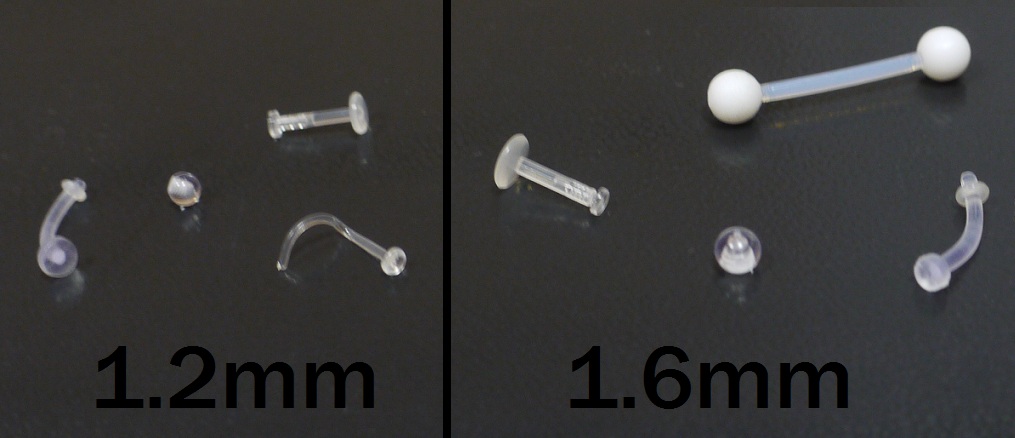
4) If you are considering having the piercing re-done, call in and see me (or return to the place it was originally done, or see any other piercer) BEFORE taking it out as there may be other options (changing jewellery for example). If it needs to be re-done, any scarring will have to be fully healed (white) before it can be re-done, this usually takes a few months.
Leaving Piercings Out For Short Periods Of Time
Leaving jewellery out of a piercing of a relatively small gauge (thickness) for more than a few minutes is not a great idea. There is no set time that it’s guaranteed a piercing will (or will not) close up. There is no formula to give any estimate on how long a piercing will stay open after jewellery is removed relating to how long the piercing has been there.
Larger gauge piercings and stretched piercings (stretched earlobes for example) may not close completely quite as easily, but it can shrink a little, usually a massage with some vitamin E cream is enough to help it through, but ‘standard’ piercing sizes – 1.2mm and 1.6mm – can close much faster than you’d think!
Some people can leave their piercings out for months, and still get them back in; some will struggle after a few minutes. Different placements on the same person can mean different things – some may close faster than others. In short – there’s no hard and fast answer to how long any piercing can be left out for.
Ideally, piercings will not be left without jewellery – you should assume that if you take your jewellery out and do not replace it within a few minutes it will close.
Depending on your reasons for needing to leave the piercing out, there may be other options. If it’s for an operation or scan, or to hide it for work, retainers might be an option – see point 3 above – the plastic retainers are ideal for scans and operations too, as there’s no metal at all in there.
Often if a piercing has been left without jewellery, even if it’s shrank, it can be helped through with some lubrication and a small taper (I offer this service, as do most other piercers, though there may be a small fee – or if you have lost the jewellery, most piercers, myself included, will offer a free fitting with jewellery purchase) – THE SOONER YOU TRY TO GET A PIECE OF JEWELLERY BACK IN, THE BETTER! I see clients for this reason who will come in with their jewellery asking for help, and then tell me it’s been out for a month – meaning the chances of getting it back in are slim, but it’s worth a try!
(Just while we’re on the subject – NEVER carry jewellery loose in a handbag, purse or wallet. It can get damaged and scratched and coins are FILTHY and you could spread bacteria to your piercing. ALWAYS use a grip-seal bag – ask your piercer for some! – to carry and store your jewellery!)
To prevent accidentally losing the jewellery, make sure screw ons are secure (righty tighty, lefty loosey! – or clockwise to tighten, anti-clockwise to loosen), and if you DO lose a ball, get a replacement ASAP (secure the jewellery with some medical tape or a plaster to keep it in!) Your piercer will stock spare balls, so it may be worth getting a couple of spares in case they are needed!
CHANGING JEWELLERY
If you’re taking your jewellery in and out yourself and changing it, familiarize yourself with it BEFORE taking anything in and out. There’s definitely a ‘knack’ to changing jewellery, and the only way to get it is with practice. Bear in mind that most piercers (me included) will fit any jewellery bought in the studio free of charge, so there’s really no need to change it yourself unless you really want to – I’m happy to show you how the jewellery works while I change it for you.
I have another full blog up about changing/fitting jewellery – so check it out if you need some info on this.
RE-OPENING & RE-PIERCING
If you can’t get a piercing back in, return to your piercer for advice. As mentioned, sometimes piercings can just shrink a little, and re-opening them is possible (not actually making a new hole, just making the old one a little wider to allow jewellery through). It nips a little, and will feel tight for a few days; it’s a similar procedure to stretching a piercing, just on a much smaller scale and as a one-off. It’s important to use good quality titanium jewellery and treat it like a ‘new’ piercing for a week or so. There may be a small amount of blood (we’re talking the TINIEST amount) and some tenderness or swelling, but usually within a couple of weeks its back to normal.
If the piercing has closed completely, re-piercing is an option. If there has been any infection, or the piercing has been ripped or torn, you will have to wait until it’s fully healed (scarring has turned white, no dry skin, scabbing or irritation) before re-doing it.
The procedure for re-piercing is the same as a ‘normal’ piercing procedure. If the old piercing was in a good position, then it can be re-done in the exact same place (and will often heal faster) re-using the holes. If not, or if there’s no visible marks or dimples, an entirely new hole is made. Most people don’t notice a huge difference in the pain or discomfort of getting something re-pierced, some say it’s more painful, some say it’s less. I never noticed any difference, personally.
Microdermals/skin divers and surface piercing don’t always cope well with a re-pierce, and it’s usually a better idea to position it as near to the old site as possible.
If a piercing has grown out or migrated, there is no guarantee that re-piercing will mean it won’t do the same again. It can sometimes fall back into the ‘old hole’ too, if pierced very close to it.
Hope this answers some questions! As always, comment below with any queries or comments!