
Scarification is a form of body modification which is gaining popularity, it is subtle (once healed) and is 100% ‘organic’ – meaning there are no foreign bodies in your skin – ink, jewellery, silicone, etc. I have used a lot of photos found online for this blog, as they give a wide spectrum of designs and techniques, but couldn’t find who to credit for some pieces – if anyone can tell me the artist behind the fantastic pieces I feature in this blog, drop me a line and I’ll give them the credit they deserve!
I’ll try to cover the main points in this blog, but if there’s something I don’t explain clearly enough, or something I miss out completely, get in touch via a comment and I’ll answer it to the best of my ability!
So, without further ado…
This is your skin! You can see the layers, which are what we deal with in scarification procedures.
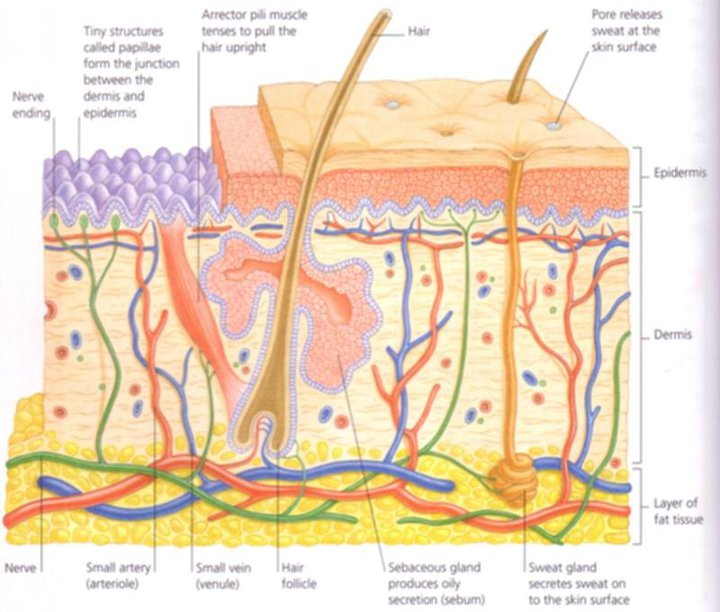
WHAT IS SCARIFICATION?
It is exactly what it looks like.
It’s the process of cutting the skin with a blade (A scalpel handle with a disposable blade, a fully disposable scalpel and varying sizes of disposable dermal punches) in a pattern or design, and when the skin knits back together and ‘heals’ the white scar is left in the shape of the design. There is no ink used – I’ll come to that in a sec – and it is your body that makes the scar, no foreign objects in your skin. The pieces usually scab up after a week or so and may look a bit ‘fuzzy’ until it heals completely, when it will be much sharper (excuse the pun). Thicker ‘lines’ on pieces can be achieved by double lining (making 2 parallel cuts and removing the skin between them). See below for more info on skin removal.

Basic Scarification (fresh)

Healed (1 year) scarification piece
Ink CAN be used immediately after cutting to give a slightly darker scar, this is known as ink rubbing. Most people mistake ink rubbing for a tattoo, it’s less popular than scarification but gives more defined results. It is still used in many tribes as a marking, often using ashes. In modern body modification circles, tattoo ink is used.

Ink Rubbing by Leah Stanmore
www.facebook.com/leahstanmorescarifiaction
Another area of scarification is skin removal. This is where the top layer of the skin is removed completely, this usually leaves a slightly more raised scar which will turn white eventually, but can take much longer than scarification to heal. A scalpel (or dermal punch) is used to cut around the ‘shape’ of skin to be removed, it is then lifted away from the second layer of the skin and a scalpel is used to remove it. It is very common to see scarification pieces which also incorporate skin removal.

Fresh Skin Removal Piece

Healed Skin Removal Piece
As mentioned, another process for scarification is the use of dermal punches. As some of you won’t know about dermal punches, they’re like little (very sharp) cookie cutters (only round ones are available). They are often referred to as Biopsy Punches, O-Needles or chamfer needles.
They look like this:
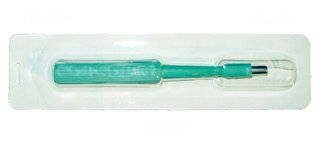
They come in different sizes, 1mm, 1.5mm, 2mm, 4mm, 6mm, 8mm, the size is the diameter of the ‘circle’ of skin they cut.
They can be used in 2 ways:
To give a perfect circle of scarification.
To remove a perfect circle of skin.

This was a piece done to incorporate some scars from microdermals as well as existing microdermals – it’s shown here at 2 weeks old. Some areas were removed, some just left as a ‘circle’
HOW CAN I GET ONE?
Scarification is available to people over the age of 18. It is a permanent alteration and irreversible process. However, tattooing over the scar will make it less noticeable, but remember – the differing texture and contours of the scar will still be there.
People who suffer from Keloid scaring, haemophilia or any other skin conditions (eczema, numerous allergies, etc.) should avoid scarification, as should pregnant or breastfeeding women. If a medical condition means that scarification can be a problem, getting a tattoo done using white ink only can give a very similar effect (though pregnant or breastfeeding women should avoid tattoos and all body modification until 6 weeks after the birth/finishing breastfeeding). White ink tattoos will give a similar effect, but over time, white ink can gain a slightly yellow tinge.
Most practitioners don’t like doing scarification pieces on people who have not had other modifications done (extensive tattoos/piercings, etc.), as scarification gives such different results from person to person, you need to be prepared for it to heal differently to what you’d expect. It’s something that should NOT be taken on a whim and you need to think very carefully before getting scarification done. A lot of people will judge you more on a scarification piece than on a tattoo. It’s usually pure ignorance, but there is a huge taboo on scars and self-harming (even though getting a professional scarification piece is not SELF harming), and people will have reservations about you if you have a scarification piece. If your artist does not feel comfortable working on someone, they will not work on them. Most artists will insist on a consultation before every piece and will tell you in this consultation if they will be happy to work on you. A lot of people will get the desired effect by having a white tattoo (being tattooed using only white ink). White tattoos can give much finer detail than scars and they heal faster and flatter than scarification, which can heal differently from person to person. Tattoos tend to heal more-or-less identically on everyone (depending on how good your tattooist is).
As far as the process goes, the initial consultation will be carried out, and when it’s time for the ‘big event’, you will be asked to fill in a consent form, just like a tattoo, and you can choose from an [almost] infinite amount of designs. With scarification pieces, the simpler designs often give the biggest impact. With scarification, there are 2 options “scarred” or “not scarred”. It’s like body modification in binary. You can’t have ‘shading’ like on a tattoo, though I have seen beautiful pieces with cross-hatching (criss-crossed lines) to give the impression of shading, these are usually larger pieces. As with tattoos, the bigger the design, the more detail that can be packed into it! It’s best to discuss your piece with an experienced professional before undergoing it, and take on board any points they make about changes to the design.
WHY IS IT SO POPULAR?
Personally, it’s the idea that no foreign materials are in my skin (sure, I have tattoos and piercings too, but my scarification pieces are all ‘me’). The idea that my body can create such beautiful patterns all by itself, especially from something as “negative” (for want of a better word) as a cut or wound is appealing. A lot of people who self-harm wear their scars with pride, like a soldier proudly showing off war-wounds, and I suppose scarification can also fall into this category. It is much less ‘obvious’ than a tattoo (once healed), and this appeals to people too. Everyone has their own reason for getting scarification – please share your thoughts or experiences in a comment.
HOW IS IT DONE?
This is the most commonly asked question with scarification, and it is exactly as it looks – cutting the skin with a blade. Obviously, there’s the usual routine, choosing a design, discussing it with your scarification artist and finalizing it. Then filling in the consent form, etc. It is recommended that you have something to eat and drink before starting, and your artist will constantly check that you’re feeling OK and make sure there’s a glass of water and an open window nearby!

This shows a piece in progress. The transfer is made and used in the same was as a tattoo transfer.
As you can see, there’s some blood. Scarification bleeds more than being tattooed, this is because tattoo needles perforate the epidermis, the ink particles are held in the collagen between the epidermis and the dermis. The scalpel cuts through the top layer of the epidermis, with no breaks, so there are more of the tiny blood vessels that come to the surface of your skin (capillaries) that are severed.
Once the skin has been cut, any pieces to be removed are taken off, using a scalpel and a pair of tweezers, the top layer of the skin is separated, and the connecting tissue is severed.
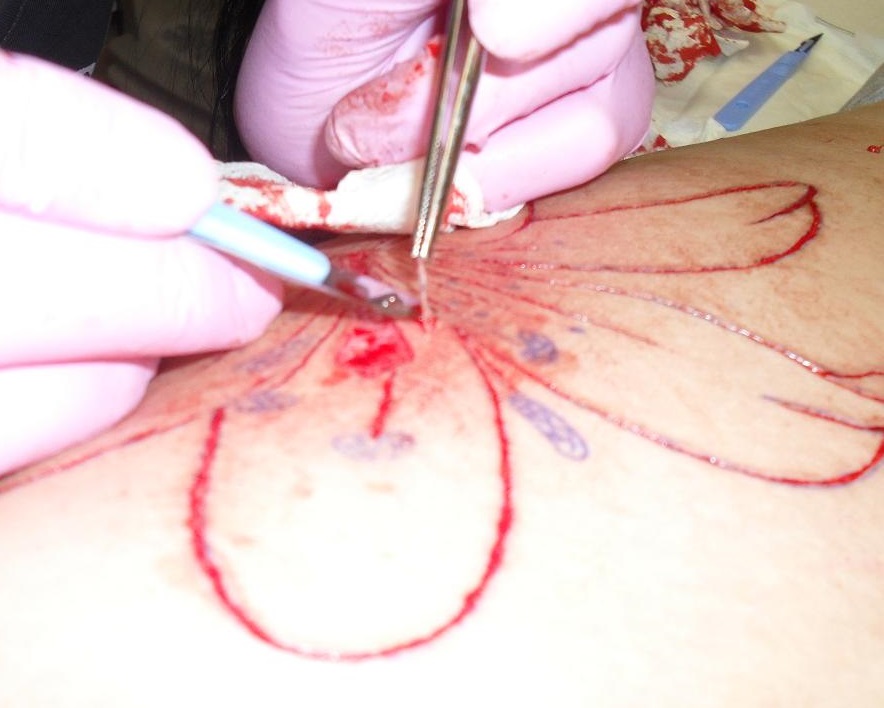
This is the same piece as shown above, you can see the skin being removed (held up for the camera).

The skin is removed completely
Then the area is cleaned thoroughly and checked to make sure depth is even.

Finished pic of the last 3 pics – you can see the removal done with a dermal punch too – this one is a great example of all the applications of scarification (except ink rubbing)
Once thoroughly cleaned, the piece is covered (usually with cling film) this can be removed once the bleeding has completely stopped (usually takes about 30mins, it is recommended to leave the cling film on until you’re home). More aftercare advice below….
HOW DO I LOOK AFTER IT?
Once you remove the cling film, wash the skin with warm soapy water and pat dry GENTLY with a clean towel, try and avoid anything ‘fluffy’ as the fibers could get stuck in the wound and potentially cause an infection (using clean kitchen roll is ideal). Allow air to the area as much as possible and wear loose clothing over it. Picking or irritating the area can give a raised effect, however skin removal usually raises on its own and scarification lines could be made uneven by picking at the scabs. Irritation is usually reserved for brands (see other blog). Once the scabs have formed, there’s no need to cover the piece with a dressing unless working in a dusty or dirty environment, and make sure you keep tight clothing off the piece until all scabbing has gone. Using a small amount of vitamin E cream on scarification while healing, but after the scabs have gone will soothe it and minimise any itching.
This link explains it all, thank you BME! http://wiki.bmezine.com/index.php/Scarification_Aftercare
WHAT DOES IT HEAL LIKE?
Aah, the million-dollar question! Everyone heals differently from cuts and scrapes, and scarification is no different. With basic scarification, most people end up with a white scar in their desired design (almost the same effect as a white tattoo) though sometimes the scars will be slightly raised. With thicker lines or skin removal, the scar will more than likely be raised and can look pink for a long time after the initial procedure; it will usually turn though. Aftercare and peoples’ genetics are the biggest determining factors in healing scarification. Different skin tones can give different results too. It is best to research the varying healing possibilities before getting anything done. Also, I recommend getting a small piece (or something which can be incorporated into a bigger piece at a later date) to start with to see how you go. It can take up to a year before a scarification or removal piece is fully healed (by ‘fully healed’ I mean that the scar is white and hasn’t changed colour/shape or caused any irritation in at least 6 months)
DOES IT HURT?
Yes.
But I found it easier than getting tattooed. As with a tattoo, twitches and jumps will knock the scalpel and result in an uneven piece. It’s much easier to put right a tattoo than a scar.
OTHER USES/INFO:
It’s worth noting that scarification dates back a long way, and a lot of South American and African tribes still use scarring as a rite of passage and status indicator. It was done to scare off enemies and as a form of spiritual protection, often done on babies and very young children.
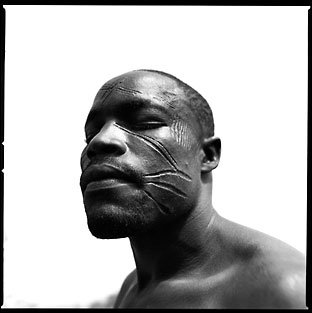
Facial Scarification (this is concave, it’s much more common to see convex or raised scarring)…
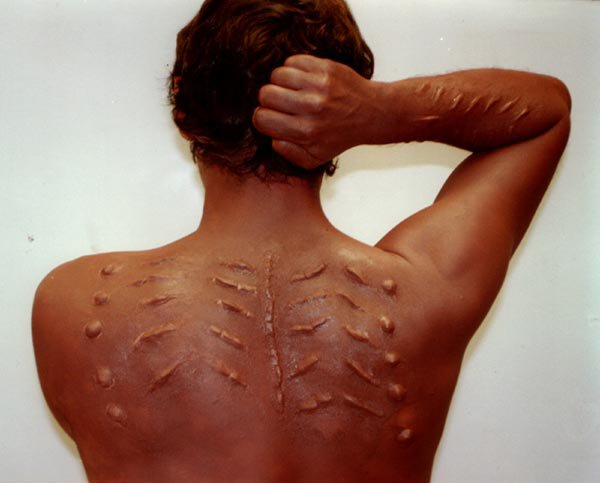
…Like this!
Another use is ‘cover up’. A lot of people use tattoos to cover scars or stretch marks. Below is a well-known piece which was used to cover some self-harm scars.
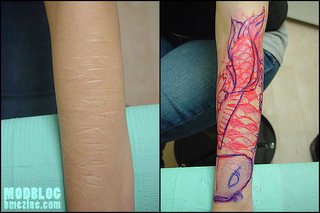

Scarification cover ups work best on thinner existing scars, or larger ones that could be incorporated into the piece. Bear in mind that it’s not likely you would mask or hide any scars perfectly, its likely they will always be visible, and the added-in scars may heal differently to the original scars.
I think that pretty much covers it!
Any more questions or queries, or experiences – post a comment!