
Anaesthetics and ‘numbing’ piercings is something I get asked about a lot. Most people are under the impression that piercings hurt a LOT more than they actually do – but when you’re a bit scared, doing something new (or if you just plain don’t like the idea of pain), it can be something you ask for to make the experience as easy as possible. No judgement from me here!
**DISCLAIMER – I DO NOT AND WILL NOT USE ANY ANAESTHETICS OF ANY DESCRIPTION IN PIERCING PROCEDURES AND WILL NOT PERFORM ANY PIERCING PROCEDURE ON AN AREA THAT I KNOW OR BELIEVE TO HAVE HAD AN ANAESTHETIC APPLIED** (This is discussed later at greater length later).
What Are Anaesthetics?
Anaesthetics are strictly controlled medicines which are used in hospitals and ‘medical’ environments so that a patient feels no pain, or is not aware of the procedure they are undergoing – they fall into 2 categories (local – which is where the area is ‘numbed’, and general – which is where you’re ‘put under’ and are asleep for the procedure).
General anaesthetics in the wrong/unexperienced hands are extremely dangerous. Medical professionals are trained specially in dosage, use and administration of these, and the meds are never seen anywhere outside a surgery situation. A patient is either completely ‘asleep’ or they are ‘sedated’ (which means they are conscious, but not fully aware of their procedure – often having no memory of it after the sedation wears off).
Local anaesthetics are split into a further 2 groups – topical (usually creams or gels, but also liquid sprays) anaesthetics are used on unbroken skin and often rubbed in or covered with a non-porous dressing and left for a period of time. They give a short-term effect and are often found in other medicines like ulcer gels and antiseptic creams. The second type of local anaesthetic is one administered via injection into the tissue (under the skin).
The use of injectables is prohibited outside a medical setting and training is needed. This type of anaesthetic is never used in body piercing.
When Are They Used In Piercing & Tattooing?
Topical anaesthetics are seen in the body art industry, for the sake of being thorough, I will cover tattooing too – but piercing is my focus.
For tattoos the most commonly used brands are Emla and Ametop – these are both tubes of white gel/cream which are usually available without a prescription. Commonly used before injections (before a cannula or ‘drip’ is inserted, or for injections, such as a diabetic patient using it before an insulin injection for example) you can request them from a pharmacist. Tattoo studios are not permitted to sell these anaesthetics, so clients are asked to buy and apply them themselves (an hour before the appointment is usual), and these will usually give 40mins to an hour of ‘numbness’ on the applied area, which gradually wears off. There are other brands on the market – such as TKTX which are not regulated and can be risky to use.
There are liquid sprays that can be used in tattooing (the most commonly seen is Bactine, which is not readily available in the UK). These are applied to broken skin (they DO NOT work on unbroken skin), rubbed in, left alone or covered with a non-porous dressing for 20-30mins, then wiped off and the procedure continues.
Anaesthetics more commonly seen in piercing are an ethyl chloride spray often called a ‘freeze spray’ – it is a pressurised, sausage size/shaped glass tube which, when the metal cap is pressed, gives out a stream of clear liquid. This often causes the tissue to go white. The tissue is ‘frozen’ before piercing it. The second type seen is Xylocaine, an oral (for use in the mouth) anaesthetic which contains lidocaine, often banana flavoured. This usually comes in a small, rounded bottle with a plastic ‘straw’ type applicator.
Why Should They Not Be Used?
We’ll look at both types in more detail (WHY we don’t use them) but first, it’s important to note that the use of any anaesthetic in body piercing (unless a piercer has had medical training) is not permitted by local councils, and further to this, no insurance company (that I am aware of!) will cover a piercer for the use of anaesthetics. Anaesthetics can cause longer healing times, there is no way to know if a client will be allergic to an anaesthetic – an anaphylactic shock would require medical treatment, and the use of anaesthetics presents an additional risk to the procedure – which are my reasons for not using or piercing anyone who has used either type.
What Are The Anaesthetics That Are Sometimes Used?
Ethyl Chloride Spray (Chloroethane)
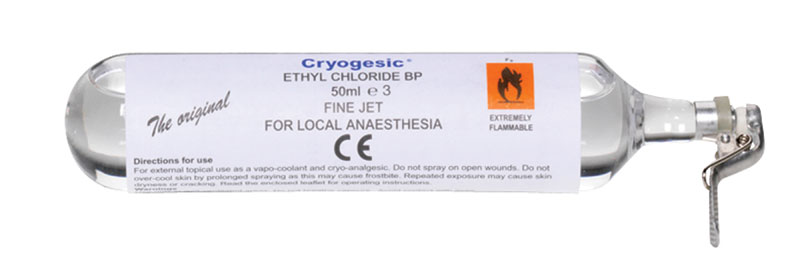
A clear, odourless, flammable liquid in a pressurised glass container. It is sprayed onto the area to be pierced a few seconds before the needle is used and it – literally – freezes the skin. The affects last about 15-20mins (so very short term) and then you will feel any after-pain from the piercing.
There’s a few reasons we don’t use this one (aside from legalities/insurance). The main issue being that when the skin/tissue is ‘frozen’ it will contract, thus meaning that a piercing that looks straight and well-placed may end up crooked or too deep/shallow as the skin expands, as the circulation returns to the area. Speaking of circulation…. Any blood vessels in the area will also contract, meaning they are not visible – and could be pierced. As the tissue is frozen for several minutes, no bleeding will occur, until the client has left the studio. Repeated exposure – so if client has the anaesthetic applied, then needs a little time to compose themselves, sensation starts to return, so the spray is used once more – can cause the skin to dry out and crack – and obviously damage to the tissue. Ethyl chloride cannot be used for facial piercings, due to the risk of it getting into the eye area.
As the most commonly seen anaesthetic in piercing, many of my clients expect to see it used. The simplest way to explain why it shouldn’t be used – though I hate using the word ‘butcher’ in a professional environment – is to think of a butcher. They don’t bring frozen meat out and start cutting it up, do they? Piercing frozen tissue requires a lot of force, it is much harder to do, takes a fraction longer, and as the effect wears off, you will feel the after-pain. In winter, if you go out in thee cold with no gloves on, then go into a nice warm house, your fingers often tingle and sting as the restricted blood flow returns – this is what happens when using any type of ‘freeze spray’.
Xylocaine Spray (Lidocaine)
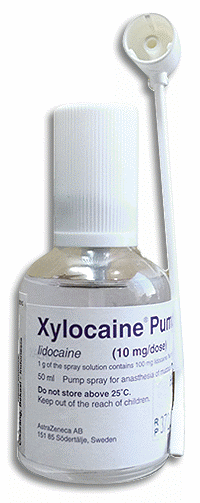
Lidocaine is an anaesthetic most commonly used by dentists. It’s usually flavoured (spray is banana, the pink gel is usually bubblegum). The spray is far more common to see in use for piercings. The applicator (shown next to the bottle in the pic) must be appropriately processed (sterilised) after each use. It is sprayed onto the area – the mouth is its most common use in piercing.
Lidocaine is a commonly used anaesthetic and it can be injected (the solution used as a spray CANNOT be injected). The effects of the oral spray used in piercing will last for about 20-30mins, so a short-term anaesthetic. With all oral anaesthetics, there is a risk of biting the tongue/cheek without noticing, due to it being numb, and lidocaine must be used with caution on anyone who has any heart defects or irregularities. As with any medication, there’s a risk of an allergic reaction and if swallowed, it can cause vomiting (not good over a fresh piercing!) and in some cases, lidocaine can cause veins to enlarge – meaning you’re running a much higher risk of hitting one if you don’t check thoroughly! Lidocaine can also cause an ‘asthma attack’ if used on clients that suffer from asthma. Scary stuff!
What If I Use An Anaesthetic Myself?
Whilst the above are the most common anaesthetics that would be used BY piercers (again, not entirely legal for this use, nor covered under any insurance policy I’ve ever seen), clients often take it upon themselves to use the topical creams mentioned in the first section, which are often used for tattooing (Emla and Ametop) and apply these themselves before getting pierced. A client applying an anaesthetic themselves, then getting pierced (NOT the piercer applying for them) does not break any laws, but it would be a grey area for an insurance issue – the reason I wouldn’t pierce someone in this instance is the other reasons listed – chance of allergic reaction, problematic healing, the additional risk of another product being used without a further risk assessment on the procedure – but also, if there were an adverse reaction, guess who’d be taking the blame???
I am seeing more and more people using Emla and Ametop – I WILL refuse service if these have been (or if I suspect they have been) used on the area to be pierced. I would be happy to offer an alternative (if client has used it on one ear but not the other, I would be happy to pierce the other side) but if not, I would need 24hrs to be sure that any affect (desired or side-effect) has presented and then worn off.
These creams would generally not work well enough to numb a piercing, as they do not penetrate deeply enough to fully numb the area, making their use somewhat futile. So, the risks listed are taken for nothing, it wouldn’t be numb, AND you’ve added a whole host of obstacles to what was originally a pretty straightforward procedure.
But I Don’t Want It To Hurt!
In that case, piercing may not be for you! It’s gonna hurt – only a tiny bit, and only for a split second…. But yes, you WILL feel some discomfort. Piercing is (should be!) quick. We’re talking a second or so for the needle to get through and stop moving, then another second or 2 for the jewellery insertion. After that, it will feel tender, tingly and/or warm, but not painful, just a mild discomfort.
If piercing DIDN’T hurt, it wouldn’t be exciting. It would be as dull as having your toenails trimmed. To get the ‘rush’, you need the sensation. And it may mean you need a few months of toying with the idea of a piercing, but as soon as the ‘want’ for it outweighs the perceived thought of how much its going to hurt, you WILL get it done.
One phrase every piercer has heard countless times is “It was nowhere near as bad as I thought it would be!” Ask friends and family about their piercing experience, find a piercer you trust and feel at ease with (this may be a different piercer to your friends!) and take the plunge!
Further Reading:
Lynn Loheide (Seattle, USA): https://www.lynnloheide.com/post/numbing-cream-and-piercings-is-it-safe